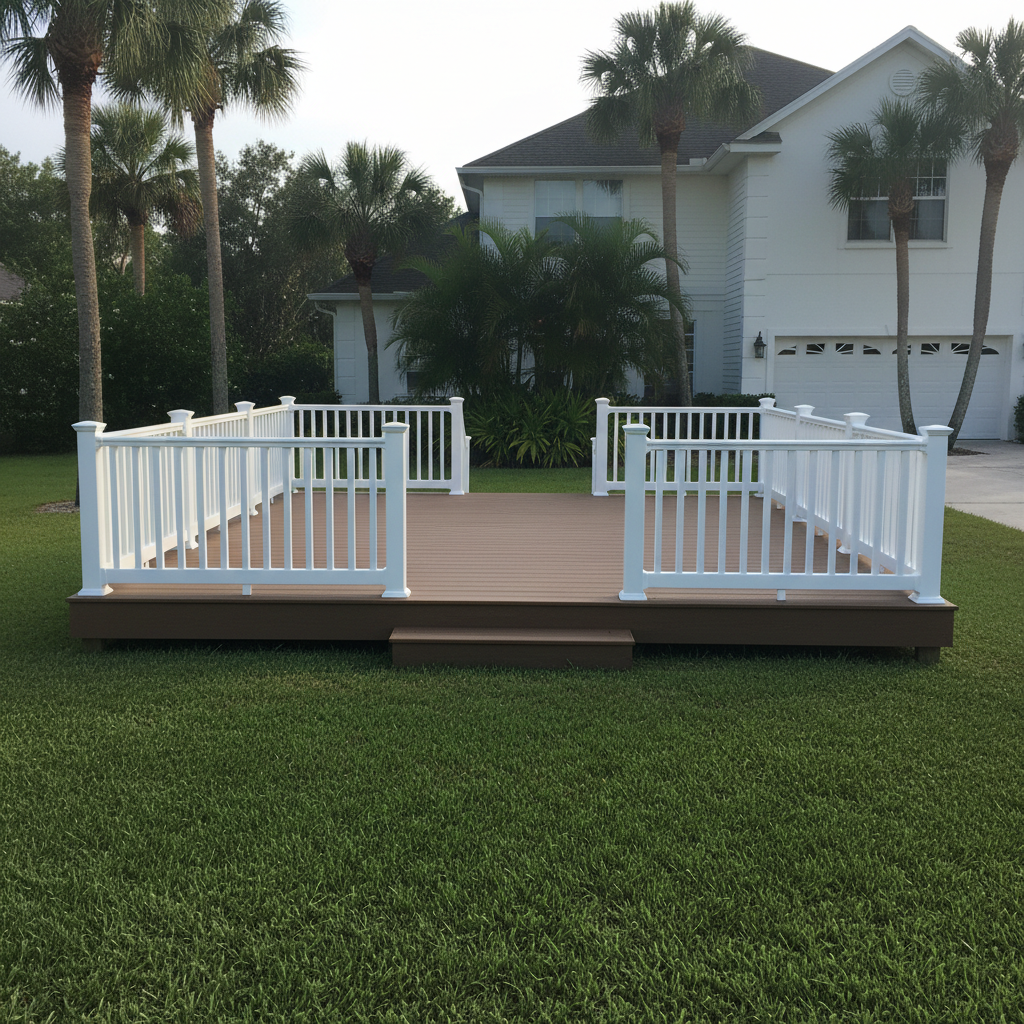
A deck in North Port works harder than a deck almost anywhere up north. It sits under sun that bakes sealant by July, gets soaked by afternoon storms from June through September, and has to shrug off wind loads from a storm system that might come through in October. Then there's the ground underneath it, which is mostly sand, and the termites that live in that ground year-round because it never freezes long enough to slow them down. Picking the right person to build it matters more here than it does somewhere with mild weather and no hurricane season. Here's what actually separates a builder worth hiring from one you'll be calling back in two years.
Start with the license, not the sales pitch
Florida requires contractors doing this kind of structural work to hold a state registration or certification, and you can look that number up yourself before you sign anything. Ask for it. A legitimate builder gives it to you without hesitation, usually printed right on the estimate. If someone hands you a business card with no license number and a story about how they've done decks for years, that story isn't proof of anything. Ask about general liability insurance too, and ask to see the certificate, not just hear about it. If a worker falls off a ledger board 10 feet up with no coverage, that liability doesn't disappear. It lands on the homeowner.
A permit is not optional, no matter what you're told
Most elevated or attached decks in North Port need a permit through the city's building division, and that usually means a site plan, a setback check against your survey, and inspections at the footing stage, the framing stage, and again at final. A screened-in deck addition or a pool deck that changes drainage on the lot may also need a look from the county, depending on where your property falls. Some contractors will offer to skip the permit to save you a few hundred dollars and a couple weeks of waiting. Don't take that deal. An unpermitted deck can hold up your home sale later, since a buyer's inspector or the county will eventually find it, and it can void your homeowner's insurance claim if that deck fails in a storm. The permit is also the only paper trail proving someone with credentials actually checked the footings before they got buried.
What this climate does to the materials, and why it should change what gets built
Pressure-treated pine is still the standard framing lumber here, but it needs to be rated for ground contact if any post touches soil, and the fasteners matter more than people think. Treated lumber today is usually ACQ, which reacts with plain galvanized steel and eats it over a few years. A builder who knows the area uses hot-dip galvanized or stainless fasteners and connectors, not whatever's cheapest at the hardware store. Hurricane straps and Simpson Strong-Tie hardware at the ledger and post connections aren't optional extras here, they're what keeps the structure attached to the house when wind gets under it. Composite decking like Trex or TimberTech holds up well against our humidity and doesn't rot, but it expands and contracts with heat more than wood does, so gapping between boards has to be set correctly in summer installs or you'll get buckling by the following July. And any wood-to-ground contact near a seawall or canal lot, which a lot of North Port properties back onto, needs extra attention, since that soil holds moisture longer than sand farther inland.
Ask to see the framing, not just the finished boards
Anyone can show you a nice photo of decking laid in a herringbone pattern. Fewer builders can tell you, without checking a chart, what their joist spacing is and why. Standard spacing is 16 inches on center for most decking, tighter for some composite boards depending on the span rating from the manufacturer. Ask how deep the footings go. In our sandy soil, footings usually need to go down 12 to 18 inches minimum and be sized wide enough that the post doesn't shift under wind uplift, since the sand here doesn't grip a narrow footing the way clay does further north. Ask whether the ledger board is lag-bolted and flashed against the house, not just nailed on, since a poorly flashed ledger is the number one way water gets behind siding and starts rotting the rim joist you can't see. A builder who's done this work knows these numbers cold. One who's guessing is guessing with your deck.
Red flags that mean you should walk away
- No written contract with a scope of work, start date, and payment schedule tied to stages of the job.
- Asking for full payment up front, before material is even delivered.
- Telling you the permit isn't necessary or that they'll "handle it later."
- No certificate of insurance, or reluctance to provide one.
- Pressure to sign same-day because a discount expires tomorrow.
- Can't answer a direct question about footing depth, fastener type, or joist spacing without pulling out a phone to look it up on the spot.
None of these alone is automatically disqualifying, people forget to bring paperwork sometimes. But two or three of them together is a pattern, and it's the pattern that should send you looking elsewhere.
Older neighborhoods versus newer subdivisions
A lot of North Port was platted back in the 1960s by General Development Corporation, and some of those older lots have slab foundations with grading that's shifted over sixty years, plus whatever old concrete, irrigation line, or septic infrastructure got buried without great records. A builder working on one of these lots should check before digging footings, not after hitting something. Newer subdivisions built in the 2000s tend to have cleaner surveys and more predictable drainage, but HOA rules on deck height, railing style, and even stain color are more common there too, so it's worth checking your HOA documents before you fall in love with a design. Either way, a builder who's worked multiple neighborhoods in the area will ask about this before pricing the job, not after.
A deck here is a long-term investment sitting outside in sun, salt air, and storm season, so the person building it should be someone who treats the framing and the permit with the same seriousness as the finished look. If you're comparing builders right now, take a look at our deck builder work and ask us the same questions you'd ask anyone else. We'd rather answer them before the contract than after.